

Why Michigan pothole season is coming early in 2026

Pothole season could arrive early this year
Winter arrived early in Metro Detroit which means all the havoc that leftover moisture can leave will also be a threat sooner than expected. Potholes typically show themselves in March. But road crews expect them to be out later this week.
(FOX 2) - Michigan's seesawing weather doesn't just mean whiplash from the elements for you — but your vehicle as well.
And with warm temperatures inbound later this week, it will be the state's roadways caught in the cross-hairs of melting snow and leftover moisture.
Pothole season comes early
After a freezing and snowy conclusion to 2025, Michigan's weather is about to take a hard pivot toward warmer weather.
Air temperatures are expected to climb into the 50s by Thursday, likely melting any standing snow leftover after several days of above-freezing temperatures.
Normally something that happens in the spring, the thaw will bring the unsurprising effects of cracking pavement, breaking up roads, and making driving a lot more difficult for Michigan.
What they're saying:
Road workers are preparing for it — and unfortunately, do not have a lot of advice for avoiding the cracks.
"These things can develop very quickly, unexpectedly, out of nowhere. Sometimes they're very hard to see, especially if you're driving at night and there's moisture on the road," said Craig Bryson of the Road Commission for Oakland County.
He asks drivers not to swerve if they come upon a large pothole, adding a punctured tire is better than a totaled vehicle,
Weather forecast
While Monday started off just below freezing, it won't stay that way for long. Daily lows will still send temperatures below 32 degrees Fahrenheit, but by the daytime, the warming cycle will be in full bloom, according to the National Weather Service.
On Tuesday, it will climb up to 42 degrees. On Wednesday, it will hit 41 degrees. And on Friday, temperatures will peak at 50 degrees.
Anatomy of a pothole
The formation of potholes is a common feature of late winter and early spring due to the conditions that are typical during this time of year.
According to a graphic from the Michigan Department of Transportation, there are three layers to a road that are in play when a pothole forms: the pavement, sub-base, and the soil.
Their creation begins when snow or rain seeps beneath the surface of the road, accumulating in the bottom soil layer.
As the moisture freezes in the winter, it causes the ground to expand and put upwards pressure on the pavement above. Pushing the pavement up is the first splinter of the road.
When the temperature warms up and the ice freezes, the ground returns to a normal level. But the pavement that got pushed up doesn't return with it. A gap instead now separates the pavement from the sub-base of the road.
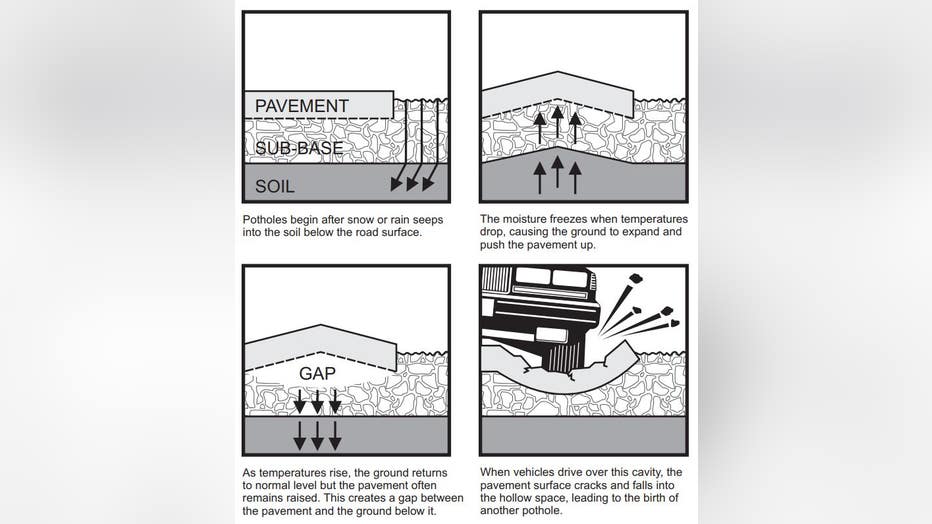
Graphic of how potholes form. Courtesy of the Michigan Department of Transportation
Then, when vehicles drive over the pavement, the weight will eventually crack the top surface, causing it to cave in. What is left is a cavity in the road, which will grow as more vehicles travel over it.
The Source: The Michigan Department of Transportation, the National Weather Service, and the Road Commission for Oakland County were cited for this story.