

ICE policy on use of lethal force redacted as questions linger following Minneapolis ICE shooting

Closer look into ICE killing of Renee Nicole Good
With many unanswered questions swirling surrounding the deadly shooting of a Minnesota woman by an ICE agent, FOX 2 is taking a closer look at the actual video of the incident and breaking down the actions of the ICE agents with the help of former Detroit Police Department Deputy Chief Steve Dolunt, and examining the renewed debate over use of force.
Just hours after a woman was shot and killed by an Immigrations and Customs Enforcement (ICE) agent, the department's use-of-force policy was redacted, nearly in its entirety.
Renee Nicole Good was shot and killed on Wednesday, January 7 in Minneapolis by an ICE agent.
The shooting happened around 9:30 a.m. CT. Good died at a local hospital and Minnesota officials questioned the agent's actions in killing the woman.
New video appear shows ICE agent's angle in Minneapolis shooting
The 2023 document has been the policy enforced by the agency and is consistent with the Department of Homeland Security's document. But now there's nothing on ICE's website but a single paragraph.
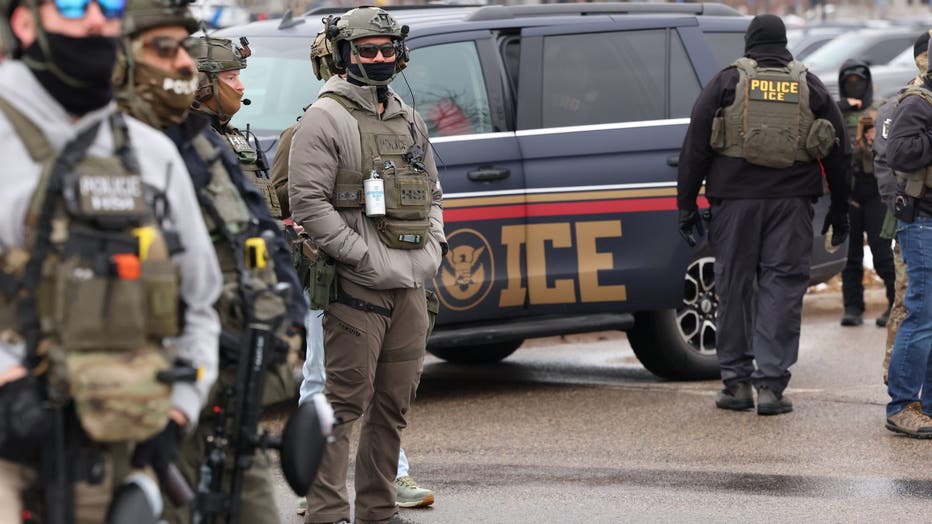
US Homeland Security Investigations (HSI) agents stand guard at the Bishop Henry Whipple Federal Building in Minneapolis, Minnesota, on January 8, 2026. A US Immigration and Customs Enforcement (ICE) agent shot and killed an American woman on the str
What we know:
ICE Directive 19009.3, which was dated May 26, 2023, is the authorative internal policy that dictates how agents should respond in high-stakes encounters when it comes to utilizing a gun.
As of Thursday, Jan. 8, the 13-page document is redacted — with the exception of the section that summarizes its purpose and background:
"Purpose/Background. This Directive establishes the U.S. Immigration and Customs Enforcement (ICE) Firearms and Use of Force policy. This Directive assigns responsibilities for agency employees and, in conjunction with the ICE Firearms and Use of Force Handbook, establishes procedures and protocols concerning firearms and the use of force, including (but not limited to) training and proficiency, the reporting of use of force incidents, and the proper maintenance, storage, and accounting of firearms and intermediate force weapons."
Beyond that opening paragraph, the remaining document is blacked out with red lettering that reads "(b)(7)(E)" — which means information is being withheld from FOIA because it "would reveal law enforcement techniques."
However, a review of the document earlier in the day on Wednesday showed that the document was not redacted.
It included detailed information about how ICE agents are instructed to use force – and when.
Dig deeper:
As recently as November 24, 2025, the use-of-force document was posted on ICE's website and dictates how agents must handle high-stakes information.
This document detailed that ICE agents may use deadly force only when necessary when an officer has ‘reasonable belief’ that the subject poses imminent danger of death or serious injury to the officer or another person. Agents are not to use deadly force if the person is only a threat to themselves or property.
Agents are also not authorized to use deadly force to prevent the escape of a fleeing suspect.
"Deadly force against a fleeing subject is only authorized if there is probable cause to believe that the escape of the subject would pose an imminent danger of death or serious bodily injury to the officer or another person."
ICE is nested under the Department of Homeland Security (DHS). By law, all sub-agencies must ensure their directives are "consistent with or exceed" the DHS master policy.
That policy is still online and contains the same language as the now-redacted ICE policy.
It includes the policy that officers are not use deadly force to stop a fleeing suspect, but may do so if they believe a suspect as a reasonable threat of imminent death to the officer or others.
What we don't know:
The exact date for when the ICE use-of-force policy was redacted is not known.
Despite the redaction, the document is publicly available online in many cases – and has been since it was first instituted in 2023.
What they're saying:
FOX 2 reached out to both DHS and ICE for comment on the redacted policies. DHS defended the use of force policy and said an ‘independent review’ of critical incidents are completed after the investigation.
A reason for the redaction was not provided.
DHS Assistant Secretary Tricia McLaughlin said, in part, "ICE law enforcement officers are trained to use the minimum amount of force necessary to resolve dangerous situations to prioritize the safety of the public and our officers. Officers are highly trained in de-escalation tactics and regularly receive ongoing use of force training."
"ICE law enforcement officers are trained to use the minimum amount of force necessary to resolve dangerous situations to prioritize the safety of the public and our officers. Officers are highly trained in de-escalation tactics and regularly receive ongoing use of force training. The agency’s current use of force policy is the same as it was in 2023 under President Biden’s administration.
"Every use of force incident and any discharge of an ICE firearm must be properly reported and reviewed by the agency in accordance with agency policy, procedure, and guidelines. All shootings are initially reviewed by the appropriate federal, state, local, or tribal law enforcement agency principally charged with first response to the incident. Following a review of the incident by the appropriate investigative agency, ICE will conduct an independent review of the critical incident."
ICE has not yet responded to a request for comment.
Dig deeper:
Former acting ICE director John Torres joined LiveNOW from FOX to discuss the case, saying that the ICE officer only had a split second to make a decision.
"The car started to speed towards the agent initially before veering off to the right. And you really only have a split second to make a decision, should you shoot? Can you dive out of the way on an icy road? It's a lot of things that go through your head, and ultimately an investigation will tell us what happened here," he said.
Attorney Lannce LaRusso, who describes himself as a law enforcement advocate, said the policy is clear – regardless of how fast a car is moving.
"When you look at the Fourth Amendment, reasonableness standard to the United States Constitution governs all of their use of force. An officer has the ability and the right to stop a deadly threat and a person hitting you with a car and driving at you with a car. Even 5, 10, 15 miles an hour constitutes a deadly threat," he offered.
The backstory:
Witnesses told FOX 9 in Minneapolis, a woman got into a red vehicle and there was one ICE agent on either side of the vehicle trying to get in, and a third ICE agent came and tried to yank on the driver's side door. One of the agents on the driver's side door backed away, and then opened fire, shooting three times through the driver's side window, witnesses said.
One witness said the vehicle wasn't moving toward the agents.
However, federal officials said ICE officers were "conducting targeted operations" when "rioters" blocked officers. One of the "rioters weaponized her vehicle, attempting to run over law enforcement officers in an attempt to kill them."
Officials said an ICE officer who was "fearing for his life" fired "defensive shots" to save himself and his officers, killing the woman.
Multiple videos circulating online show the incident from different angles, leading to conflicting interpretations of what happened. Federal officials say the agent fired in self-defense, a claim Minneapolis Mayor Jacob Frey has publicly disputed, calling it "bullshit."
The Source: Information from ICE.gov and the Department of Homeland Security