

Canada wildfires prompt Air Quality Advisory in Southeast Michigan - What to know
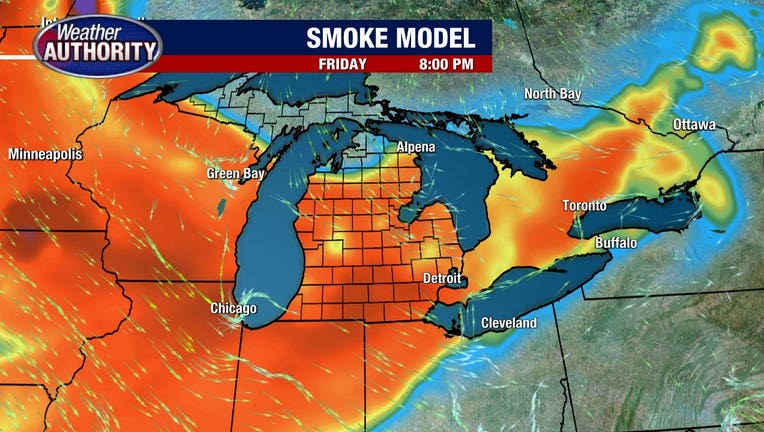
DETROIT (FOX 2) - An Air Quality Advisory was issued for Friday into Saturday as wildfires burning in Canada add particles to the air that could cause breathing issues for some.
"The 2023 Canadian wildfire event emphasized how important communication is when wildfire smoke may impact Michigan’s communities," said Annette Switzer, the Michigan Department of Environment, Great Lakes, and Energy (EGLE)'s Air Quality Division director. "We want to ensure residents are informed and know how to protect themselves and their families."
Timeline:
As of 10:30 a.m. Friday, Detroit's air quality level is Moderate, according to AirNow.
Smoke is expected to move into the area late Friday afternoon or evening. The Air Quality Advisory is currently scheduled to expire at 6 a.m. Saturday.
According to EGLE, conditions may be unhealthy for sensitive groups and there is a possibility that hourly levels could reach the unhealthy range for a short period of time.
The following counties are under the advisory: Midland; Bay; Huron; Saginaw; Tuscola; Sanilac; Shiawassee; Genesee; Lapeer; St. Clair; Livingston; Oakland; Macomb; Washtenaw; Wayne; Lenawee; Monroe.
Air Quality Advisories have also been issued for areas of northern Michigan.

Cooler but nice weekend on tap
Warming temperatures and some rain Friday lead to a cooler but nice weekend in Metro Detroit.
Dig deeper:
According to EGLE, an Air Quality Advisory is issued when two or more (or widespread) monitors are expected to reach or exceed the Unhealthy for Sensitive Groups USG, Orange air quality index (AQI) threshold.
Learn more about these levels below.
An Alert is called when two or more (or widespread) monitors are expected to reach or exceed the Unhealthy threshold.
Air quality levels
Green (0-50 AQI)
Good - Air quality is satisfactory, and air pollution poses little or no risk.
Yellow (51-100 AQI)
Moderate - Air quality is acceptable. However, there may be a risk for some people, particularly those who are unusually sensitive to air pollution.
Orange (101 to 150 AQI)
Unhealthy for Sensitive Groups - Members of sensitive groups may experience health effects. The general public is less likely to be affected.
Red (151-200)
Unhealthy - Some members of the general public may experience health effects; members of sensitive groups may experience more serious health effects.
Purple (201-300)
Very Unhealthy - Health alert: The risk of health effects is increased for everyone.
Maroon (301+)
Hazardous - Health warning of emergency conditions: everyone is more likely to be affected.
Air quality health tips:
During unhealthy for sensitive groups (AQI orange) to unhealthy for everyone air quality events (AQI red), the Michigan Department of Health and Human Services (MDHHS) advises the following:
For people with heart or lung disease, pregnant people, older adults aged 65+, children, and teens, it is suggested to take the following steps to reduce exposure:
- Avoid strenuous outdoor activities.
- Keep outdoor activities short.
- Consider moving physical activities indoors or rescheduling them.
For everyone else:
- Choose less strenuous activities (like walking instead of running) so you don’t breathe as hard. ‘
- Shorten the amount of time you are active outdoors.
- Be active outdoors when air quality is better.
During very unhealthy or hazardous for everyone air quality (purple to maroon Air Quality Index levels), MDHHS advises the following for everyone:
- Stay indoors with the doors and windows closed using MERV-13 or better air filtration.
- Seek shelter elsewhere if you do not have an air conditioner, and it is too warm to stay inside with the windows closed. Call or text 211 or contact your local health department to find out if there is a shelter or cooling center nearby.
- Use air filters to improve indoor air quality. Whether you have a central air conditioning system or a portable room unit, use high efficiency filters to capture fine particles from smoke. If you don’t have access to those filter systems, you can create a temporary air purifier with a 2012 or newer box fan and attaching a MERV-13 or higher air filter to it. Information is available online.
- Keep activity levels low.
- Avoid outdoor activities.
- Use N95 style masks if you have to be outside.Surgical and cloth masks are not recommended as they are not designed to prevent breathing in the fine particulate matter in wildfire smoke.
The Source: This information is from the National Weather Service and EGLE.