

‘Show Your Stripes Day’: These cities had the most higher-than-average temperatures

hildren hold icy water bottles to their cheeks to cool off amid the extreme heat on May 20, 2026 in New York City. (Photo by Liao Pan/China News Service/VCG via Getty Images)
As communities around the world prepare to observe Show Your Stripes Day on June 20, climate scientists and advocates are encouraging people to share a powerful visual representation of climate change: warming stripes.
The annual campaign uses colorful graphics to illustrate more than a century of temperature changes. Each stripe represents the average temperature for a single year compared with a long-term historical average. Blue stripes indicate cooler-than-average years, while red stripes represent warmer-than-average years.
‘Show Your Stripes Day’ explained
Big picture view:
The warming stripes concept, created by climate scientist Professor Ed Hawkins, spans temperatures from 1850 through 2025 and shows a dramatic transition from predominantly blue stripes to deep reds in recent decades, reflecting rapid warming and the accelerating effects of human-caused climate change.
Climate Central analyzed historical temperature data through 2025 to produce warming stripes graphics for 199 U.S. cities and 49 states (excluding Hawaii).
Strong red shifts in US reflect rapid warming
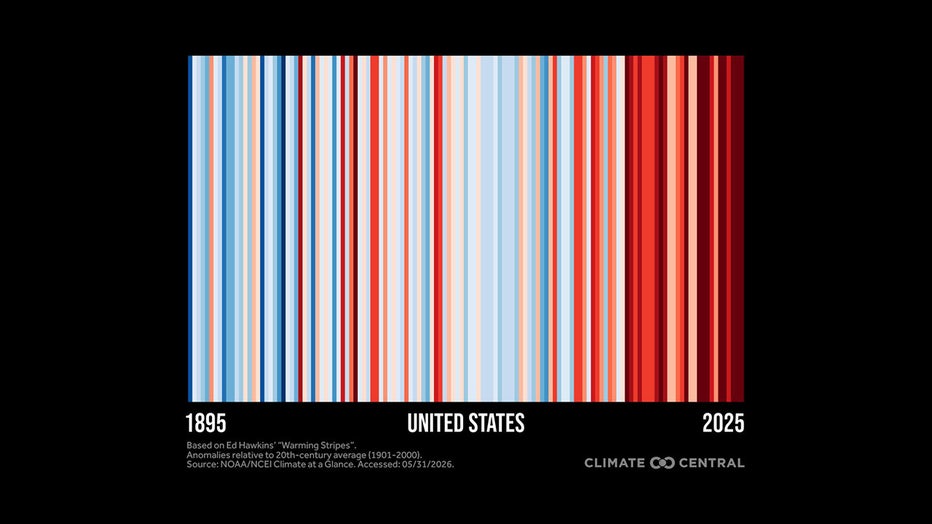
U.S. Warming Stripes through 2025 (Climate Central)
By the numbers:
Most U.S. locations showed a strong warming trend, especially in the fastest-warming regions such as the Southwest, Northeast, and Alaska.
In 2025, the following cities were warmest relative to the 20th-century average: Phoenix, AZ (6.5°F above average); Reno, NV (6.3°F); Salt Lake City, UT (5.9°) and El Paso, TX (5.1°F).
Global temperatures remain near record highs
The backstory:
Climate Central says the visualizations come at a time when global temperatures remain near record highs. According to the organization, 2025 ranked as the third-warmest year since modern records began in 1850, extending an extraordinary run of global heat that included record-breaking temperatures in both 2023 and 2024.
RELATED: Map: The fastest-warming US states revealed
Exceeding 1.5°C in a single year, which first occurred in 2024, does not mean the world has breached the 1.5°C limit set by the Paris Agreement. But Climate Central said the limit will be reached in the early 2030s if current rates of warming continue.
The Source: The information for this story was provided by Climate Central. Data for the global warming stripes graphic (1850-2025) is from the UK Met Office. The graphic displays global annual temperature anomalies relative to the 1961-2010 average. In addition, Climate Central produced original warming stripes graphics for the U.S. as follows: For U.S. cities with data beginning in 1901 or before, anomalies are relative to the 20th-century (1901-2000) average. For a subset of 48 U.S. cities whose period of record begins after 1901, annual temperature anomalies are relative to the oldest available 100-year average for each city. Weather stations with less than 100 years of data were excluded. This story was reported from Los Angeles.