

Partial solar eclipse in Michigan Wednesday

When, where, and how to watch the next big sky shows
Paulette Epstein from the Michigan Science Center joins Ronia Shamona to lay out how to make the most of the viewing experience during the solar eclipse and meteor showers, along with discussing her time with NASA.
A solar eclipse will sweep across several countries on Wednesday, Aug. 12 – with a sliver of the show happening here in metro Detroit.
Partial solar eclipse in Michigan

How to catch the upcoming solar eclipse and meteor showers
Astronomer, Mike Narlock, from the Cranbrook Institute of Science sits down with Ronia Shamona to preview the upcoming solar eclipse, potential meteor showers, and viewing parties held at the Cranbrook Institute of Science.
Big picture view:
Parts of the Northern Hemisphere, from Alaska to North Carolina and most of Canada will have an opportunity to experience a partial solar eclipse.
The total solar eclipse will sweep across Greenland, Iceland, northern Russia, the Atlantic Ocean, Spain and a small part of Portugal.
Cities in metro Detroit will see a very small sliver of the eclipse Wednesday afternoon.
Local perspective:
Here is the eclipse visibility and times for each city, according to Time and Date AS:
- Ann Arbor, 2.42% obscured, from 1:04 - 2:05 p.m., peak time 1:35 p.m.
- Detroit, 2.98% obscured, from 1:03 p.m. - 2:08 p.m., peak time 1:36 p.m.
- Livonia, 2.81% obscured, from 1:03 p.m. - 2:07 p.m., peak time 1:35 p.m.
- Sterling Heights, 3.32% obscured, from 1:01 p.m. - 2:09 p.m., peak time 1:35 p.m.
Timeline:
The partial solar eclipse will begin in metro Detroit just after 1 p.m. Wednesday, with the peak happening just after 1:30 p.m. in most cities. It will disappear just after 2 p.m.
What you can do:
Remember, it is never safe to look directly at the sun without proper eye protection.
Regular sunglasses are not safe, regardless of how dark they are.
Viewers should not look at the sun through a camera, telescope or binoculars while wearing eclipse glasses. Those devices concentrate sunlight and require specially designed solar filters attached to the front of the equipment.
What is a solar eclipse?
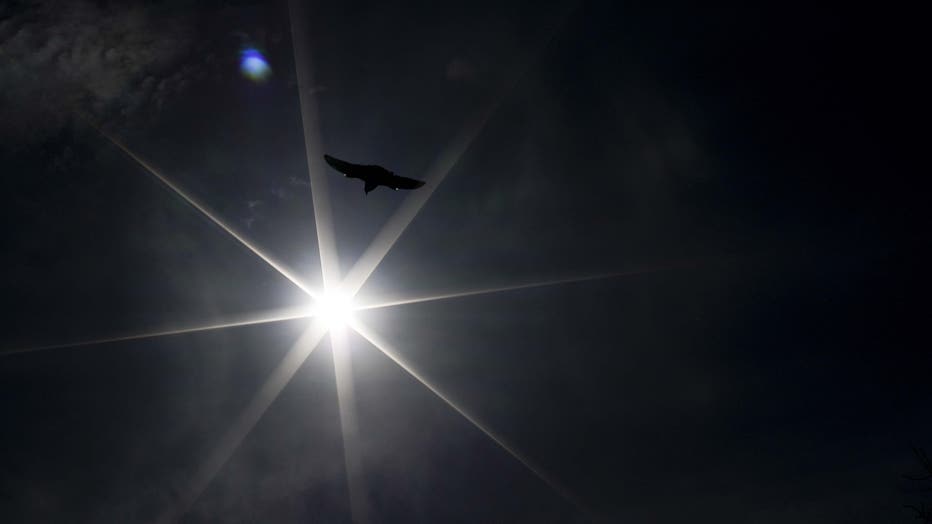
FILE - A partial solar eclipse is seen near the Brooklyn Public Library on April 8, 2024 in Brooklyn, New York. (Photo by Pablo Monsalve/ VIEWpress)
Big picture view:
A total solar eclipse happens when the moon completely blocks the sun from view.
People who are in the direct path of the total solar eclipse can witness the sun’s corona, which is typically too dim to see when it’s not covered, according to NASA.
Perseid meteor shower in Michigan
Meanwhile:
One of the best meteor showers of the year is also happening and can be seen here in Michigan.
What they're saying:
Shannon Schmoll, director of the Abrams Planetarium at Michigan State University, said the Perseid meteor shower happens every year and peaks in mid-August. It’s just a coincidence that these two celestial events are overlapping and they don’t have any other connection.
What you can do:
The best viewing opportunities to see the meteor shower will be during the early morning hours of Aug. 12, 13 and 14, before sunrise, according to Michigan State University.
Under ideal conditions, the Perseids have a zenith hourly rate, which estimates the maximum number of meteors you can see in one hour, of about 100 meteors per hour. Most people will see significantly fewer. But, spending an hour outside under a dark sky could still result in seeing a good number of bright meteors.
Get more tips on how to watch the Perseids shower from Michigan State University here.
The Source: Information in this article was taken from NASA, Date and Time AS and Michigan State University.