

PFAS remedy at Selfridge base? How volcanic clay kept forever chemicals out of groundwater

What are PFAS, the concerning 'forever chemicals?'
PFAS is increasingly being found unnaturally in water sources, food, and animals.
(FOX 2) - Specialized clay from volcanic eruptions millions of years ago may be the key to successfully preventing forever chemicals from leaching into groundwater.
That clay was deployed in the soil of the Selfridge Air National Guard Base in Macomb County where the soil has been contaminated by PFAS.
According to the company behind the burgeoning method, Fluoro-Sorb Adsorbent almost completely stopped the chemicals from contaminating the water underneath.
"The goal is to keep it out of water, preventing human consumption," said Barry Shadrix, who leads the wastewater business at Cetco. "If you can do that through sequestration or stabilized material and keep it out of the water, I think you've achieved your goal."
Its success could contribute to a longstanding effort to improve a growing public health concern around the man-made chemicals.
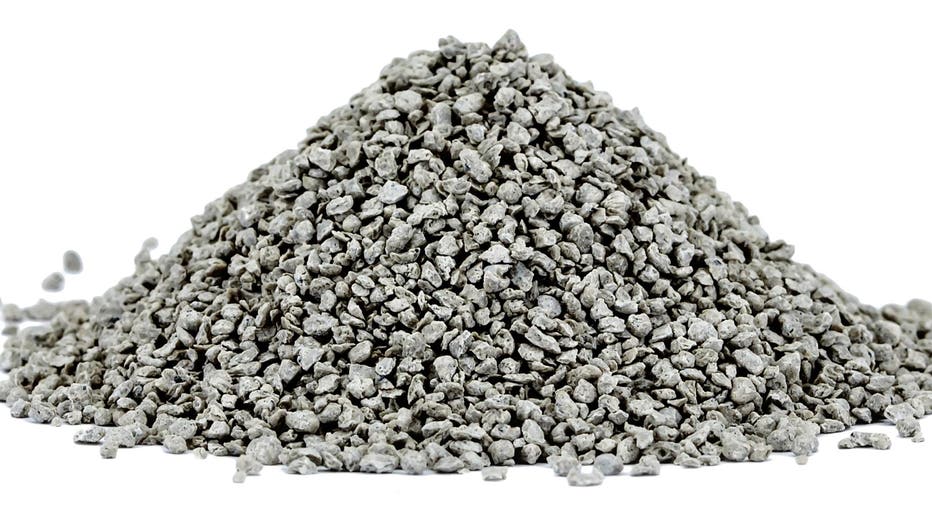
Fluoro-Sorb Adsorbent is made from bentonite clay, which formed from volcanic eruptions millions of years ago. It is mined in salt lakes in Wyoming. Photo via Cetco.
The backstory:
Selfridge is one of six military sites in Michigan where PFAS cleanup has been delayed for years. It was identified years ago as the source of contamination, which has allowed forever chemicals to leach into major water bodies like the Clinton River and Lake St. Clair.
Both supply drinking water to nearby communities in Metro Detroit.
The base, like other military sites in Michigan and around the U.S., made use of foam that's used by firefighters to train with and put out blazes. The foam was used for decades.
It's now one of numerous examples of how artificial chemicals have entered the environment and don't break down. Cities and those that manage water systems have been struggling to come up with a solution for years.
PFAS — or Per and Polyfluoroalkyl Substances — were used in many consumer products for decades because of their grease and stain resistance. But because they don't naturally break down, it has instead grown in the environment and in people.
They're linked to several health issues, including liver damage, thyroid issues, and certain kinds of cancer.
Fighting PFAS in Michigan
Engineers with Cetco, a subsidiary of Minerals Technologies Inc. and the company behind the Fluoro-Sorb technology, discussed the remediation during the PFAS 2025 Summit in early December.
The approach was designed by the U.S. Army Corps of Engineers, which opted for targeting removal across an eight-acre plot. Two feet of topsoil were removed before Fluoro-Sorb was mixed into the ground using a rotary spreader.
Cetco specifically identified PFOS, which is a form of PFAS, as the most common chemical in the area. Crews monitored the area and reported a 98 – 100% drop in PFOS chemicals leaching into the groundwater.
Dig deeper:
Underscoring the complexity of the problem, Cetco's goal was not to remove PFAS from the environment. Instead, it was to prevent it from contaminating nearby water sources.
The technology involves material that specifically attracts PFAS chemicals, bonding to them and preventing them from moving. But at the same time, it repels water, allowing it to pass through the material as it soaks up the chemicals.
"Essentially, we created a strong PFAS magnet that removes the PFAS from water and soil," Shadrix told FOX 2.
Shadrix is the global director of water and remediation at CETCO. He described Fluoro-Sorb as a deck of cards; layers of platelets stacked on top of one another, separated by a tiny amount of distance, but with an immense amount of surface area.
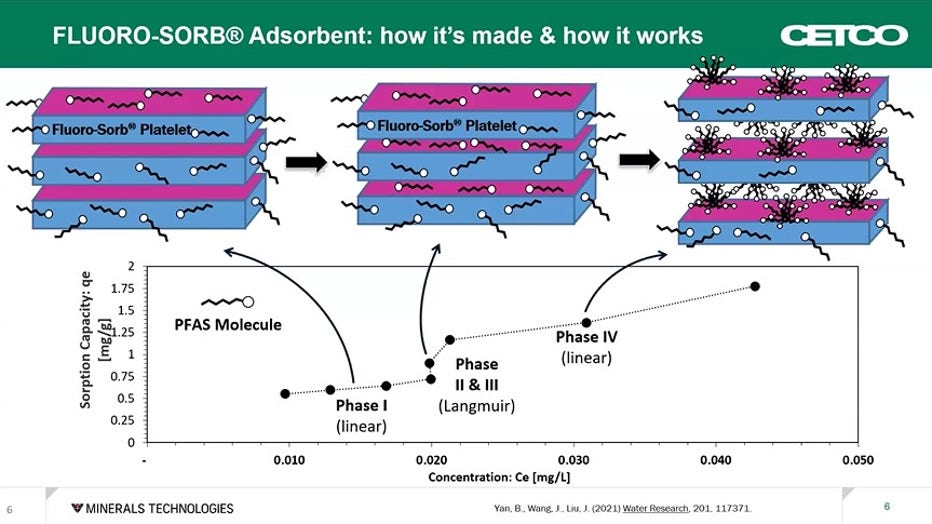
Fluoro-Sorb is made from a modified clay mineral that includes microscopic layers called platelets that stick to PFAS. Screenshot from 2025 PFAS Summit.
The surface of each of those layers has been modified with a special coating that attracts PFAS and rejects water.
"So, imagine the deck of playing cards and putting a coating over each one of those cards in the structure, and that coating makes the clay repel water instead of soaking it up like a sponge," he said.
And once it binds to PFAS, it doesn't let go.
PFAS removal technology
Other techniques for fighting PFAS include Granular Activated Carbon (GAC) and Ion Exchange resin. The former bonds with PFAS while the latter removes molecules from PFAS.
Both have been useful in remediation, but come with drawbacks, including taking a long time to stick to PFAS and attracting other more than the targeted chemical.
Fluoro-Sorb works as a hybrid of both, Shadrix said, targeting only PFAS and doing so in only minutes.
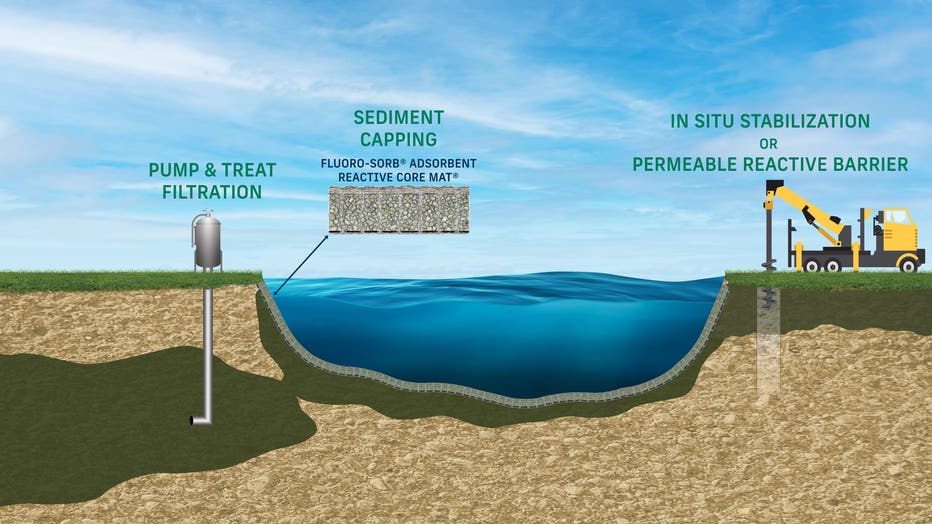
Fluoro-Sorb Adsorbent sticks to PFAS while repelling water, allowing it to purify anything passing through it and making it safe to drink. Photo via Cetco.
The Source: The PFAS Summit 2025 and an interview with Cetco were cited for this story.