

Michigan DNR: Prepare to treat invasive, tree-killing hemlock woolly adelgid this spring
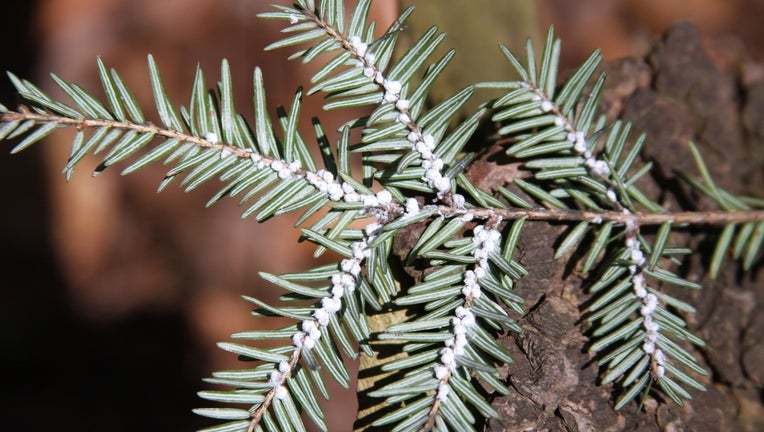
Round, white hemlock woolly adelgid ovisacs are found on the undersides of branches near the base of the needles. (Photo: DNR)
DETROIT (FOX 2) - As spring approaches, the Michigan Department of Natural Resources said landowners should look for signs of hemlock woolly adelgid and prepare to treat infestations, if present.
The invasive insect is native to Asia, but has been found in Allegan, Mason, Muskegon, Oceana, and Ottawa counties in Michigan.
(If you can't see the map below, click here.)
These pests suck sap from hemlock needles, killing the trees eventually. Typically, an infested tree will die in 4-10 years, the DNR said.
Related: Mosquitoes and ticks expected to thrive this spring, summer
Dying trees can be a danger during storms and high winds. In forests, loss of hemlock trees can reduce shade, winter cover, food and habitat for birds, fish, and mammals.
Insecticides are available to control the insect. Often, this can be applied by landowners. However, some products have restrictions on how much can be applied in a year, so a pesticide application business may need to apply the product.
If one of your hemlock trees is infested, you should treat all of your hemlock trees to prevent spread. The DNR also recommends coordinating with neighbors, so their trees can be treated as well.
Products containing either imidacloprid or dinotefuran as the active ingredient and labeled for treatment of hemlock woolly adelgid are effective in combating the insect. They are available at garden stores.
- Imidacloprid moves slowly through trees, taking at least a year to reach the top of a large tree. However, one application will protect the tree for at least five years.
- Dinotefuran moves through hemlock trees more quickly, making it ideal for heavily infested trees. Dinotefuran protects trees for one to two years.
Hemlock woolly adelgid’s cottony, white ovisacs will linger for a time following treatment. If trees are treated in the spring with dinotefuran, check new growth in late fall or winter for any fresh signs of infestation. With imidacloprid, wait until a year after treatment to gauge effectiveness.
After treatment, trees should be checked every year.
Find tips for identifying the pest here.
If you suspect trees on your property have hemlock woolly adelgid, report it using the Midwest Invasive Species Information Network at MISIN.MSU.edu. You can report from the field using the MISIN smartphone app, which will log the location and allow you to upload photos of the suspected signs of the insect.
You also can take pictures, note the tree’s location and email the information to the Michigan Department of Agriculture and Rural Development at MDA-Info@Michigan.gov or report by calling 800-292-3939. Someone will respond to let you know if hemlock woolly adelgid is present or not.
Do not clip infested branch samples and transport or mail them, as this could spread the insect.
(If you can't see the guide to ID'ing hemlock trees below, click here.)