

Dearborn Prop 1: City votes on change to wards for council members, charter
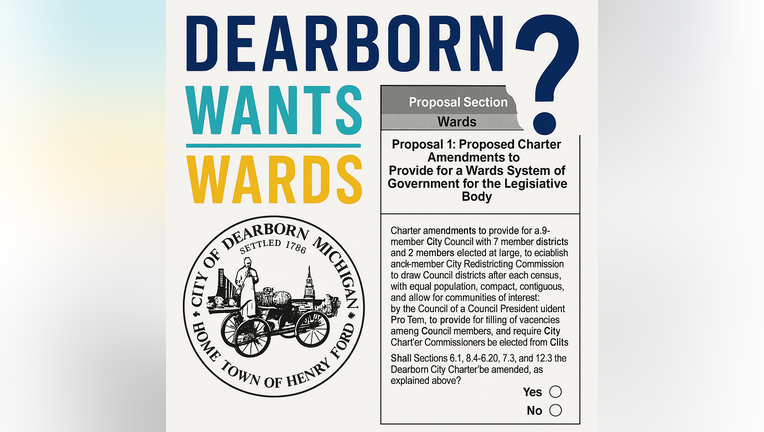
Photo art made with ChatGPT
FOX 2 - Voters in Dearborn are deciding whether to change to a ward system for the city council with Proposal 1.
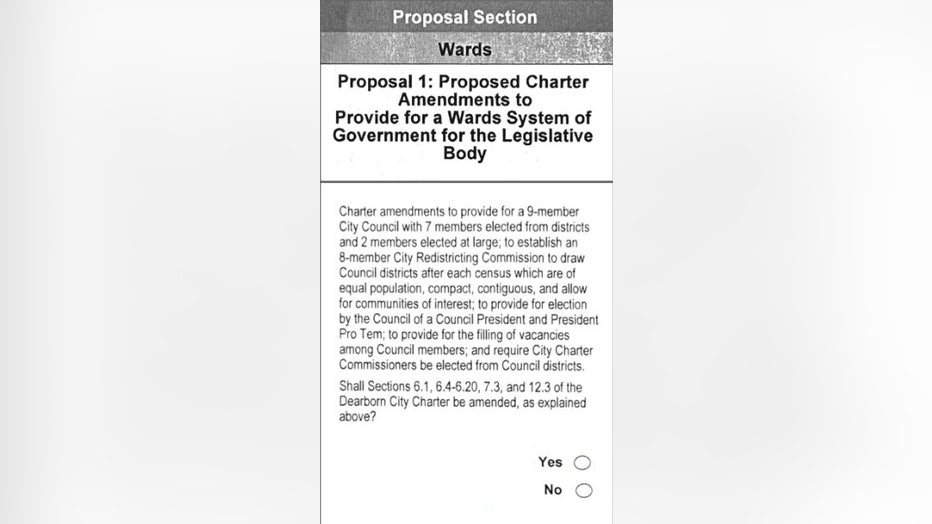
The proposal would divide the city into seven districts by requiring a commission to draw boundaries for new council districts starting in 2029, breaking up the council and assigning one representative for each section.
Two additional council seats would be added, enlarging it to nine. The two extra council seats would be considered at-large.
Proponents for Prop 1 argue that it would provide better representation for underserved areas of the city on the east side and south end, which are less affluent than the north and west sides.
Critics say the proposal is a "solution in search of a problem" pitting neighborhoods against each other and giving less representation, with three potential council members speaking for residents instead of the current seven.
For more information about other proposals Wayne County voters are casting ballots for, CLICK HERE.
What Prop 1 would do:
- Create neighborhood-based council and charter commission districts - known as wards.
- The maps would be redrawn to determine representation with an independent commission "to draw fair maps" splitting up sections of the city to pair with a council member.
- Each council district would have around 15,200 residents with that council member required to live in the section they represent.
- Expand the city council to nine seats adding two at-large seats.
- Allow the City Council to select the council president and president pro-tem. Under the current system, the top-two vote getters by residents determine the president and president pro-tem.
- Fill council vacancies with the next-highest vote-getter - which already happens, but in this case, it would be the runner-up candidate in that specific ward.
- All changes would take effect in 2029.
Other cities which use wards
In most cases, wards are used in larger cities that have greater populations like Detroit, Grand Rapids, Ann Arbor and Lansing.
Dearborn is the seventh-largest by population with about 108,000. Other cities which are smaller that use wards are Flint, Inkster, Plymouth, Rochester Hills and Ypsilanti.
Why wards?
Better representation: The grassroots effort to bring forward the proposal argues that council members who live in their neighborhoods they represent best know the issues and problems that section of the city faces.
Most current council members hail from the north and west sides where the proposal would "ensure every neighborhood has a voice at the table."
Resource distribution: Proponents also claim resources and attention will be given equitably to all sections of the city instead of just the north and west sides which already get most of the attention.
Attention to neighborhood needs: The south and east ends which border Detroit as well as its industrial southwest side, have had pollution complaints and have claimed the most damage from flooding in the past.
Why not wards?
Aside from the fundamental changes the proposal would make to the charter, opponents say that there is an assumption that council members only care about the section of town they live in.
Many, including the current council president, grew up on other sides of the city including the east end and still have family there.
It would also, the argument claims, reduce the amount of council members speaking for residents from the current seven to three - thus reducing their voice.
Division: The opposition says that the very claim of fair representation is really stoking division between sections of the city, while also taking away the voters’ ability to choose the president and president pro-tem of the council - instead handing the power to other elected officials.
Cost: The division of the city into wards would be created by a commission with outside consultants or experts in census tracts or which would take funding, This includes the redrawing of districts after every US Census for population changes - meaning after 2029, a new redrawing would be needed for the next 2033 election.
Outside money: Critics are suspicious at the large number of social justice and advocacy groups supporting the proposal. Some of which - like The Peoples Coalition of Michigan based in Ann Arbor and the American Muslim Engagement & Empowerment Network in Rochester Hills, and Detroit Action, are not based in the community.
More information:
CLICK HERE to read the proposal.
CLICK HERE for more about YES on Prop 1.
CLICK HERE for more about NO on Prop 1.
The Source: Information for this report is from both sides of the Proposal 1 argument and the Wayne County Clerk.